
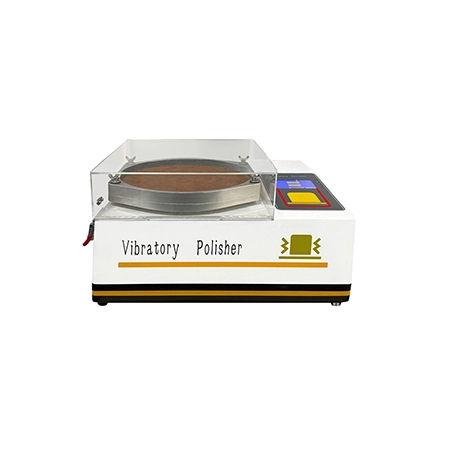
Product photography / image presentation, not a live operation
Grinding & polishing
ZDP-300
Vibratory polisher
The ZDP-300 provides vibratory fine and final polishing for specimens requiring reduced preparation deformation before microscopic or surface analysis.
TECHNICAL DATA
Technical specifications
Specifications are compiled from published references. Confirm configuration, options and delivery requirements with an engineer.
| Parameter | Specification / configuration |
|---|---|
| Model | ZDP-300 |
| Machine body configuration | Benchtop |
| Control method | Touchscreen control |
| Polishing disc size | 305 mm |
| Polishing diameter | Φ8-50 mm (custom sizes available) |
| Main unit power | 1.5 KW |
| Frequency adjustment | automatic (0-400Hz adjustable ) |
| Voltage adjustment | automatic (0-220V adjustable ) |
| Power supply | 220V |
| Dimensions | 500*480*320 mm (L * W * H) |
| Net weight | 59.5 KG |
| Gross weight | 70 KG |
| Standard configuration | |
| Main unit | 1 unit |
| Transparent dust cover | On main unit |
| Specimen holder | 3 sets each of Φ25/30/40 mm; holds mounted or unmounted specimens |
| Polishing consumables | 1 final polishing cloth, 1 bottle of 0.05 μm alumina powder, 1 bottle of 0.02 μm silica suspension |
| Counterweights | 2 pieces |
| Level vial | 1 piece |
| Power cable | 1 piece |
| Technical documentation | 1 set (manual, inspection certificate and warranty card) |
Specifications checked 2026-11-12 based on the archived public product page.
Working principle
Stepwise grinding & polishing
Each step removes the damage left by the previous one, rotating the direction by 90°, until only negligible relief remains and the structure is not smeared.
- P240 → P2000
- 90° rotation
- Diamond to mirror
Product overview
Vibratory polishing is used to reduce the fine deformation layer left by mechanical preparation and improve the specimen surface finish. The ZDP-300 is intended for preparation ahead of EBSD, AFM and SEM analysis. Its mechanical-chemical polishing action is particularly suited to soft and ductile materials, including titanium, aluminium and copper and their alloys, as well as nickel-based alloys and high-temperature alloys.
Understand the instrument in context
Select the instrument together with the material, specimen dimensions, target surface and downstream inspection task.
Explore preparation workflows →Questions before selecting
What specimen information should I provide?
Provide material, geometry, dimensions, target cross-section, batch size, current method and the problem to solve.
Are these specifications the final configuration?
The page supports preliminary selection. Confirm fixtures, consumables, power supply and optional features in the technical proposal.
Can I view an instrument demonstration?
The viewer supports image sequences, animated images and video. Image sequences show appearance and structure; refer to validated videos or instructions for operation.